
Train domain-specific models
Create proprietary models using enterprise-specific data and expertise.
Agentic AI is becoming the center of enterprise AI roadmaps. But agentic systems are only as differentiated, sovereign, and economically sustainable as the inference layer beneath them.
Enterprises use multiple models for concrete reasons. A model should not validate its own response. More expensive models should be used only when the task earns them. Specialized domain-specific models should be used for specific tasks that require domain expertise and proprietary knowledge. And of course there are cost and privacy/sovereignty-related concerns.
To execute a request, an agent can reference more than a single model, potentially through multiple model endpoints. The agent uses those calls to formulate, groom, and enrich prompts; calculate a plan; execute each step; observe and analyze results; formulate a response or update; and validate or verify the outcome.
Agentic AI multiplies inference decisions - and therefore multiplies the importance of model choice, data boundaries, governance, and cost.
Proprietary data and knowledge should create capabilities competitors cannot copy. That differentiation comes from unique datasets, company-specific insights, proprietary operational workflows and know-how, and other intellectual property.
Create proprietary models using enterprise-specific data and expertise.
Specialize open-source or open-weight models with proprietary data.
Provide private context, operational knowledge, and workflow data when the model runs.
Standard models give everyone standard capabilities. Differentiated agents require differentiated models, proprietary context, and a serving layer capable of keeping both under enterprise control.
Third-party hosted model endpoints are easy and often become the first instinctive choice. Enterprises can augment frontier models and standard open-source or open-weight models by providing proprietary data as context. But three concrete problems arise.
Private data transits infrastructure the organization does not control.
The enterprise pays for the size of the context it repeatedly supplies.
Costs grow with every model call across the agentic loop.
The deeper limitation is competitive. Choosing the same standard models as everyone else produces the same baseline capability and no unique differentiation. Overcoming that limitation requires tuning or specializing open models, or training domain-specific models on proprietary data - and those models must be hosted.
Hosting a proprietary model in a third-party inference service means handing a unique value differentiator to an external operator, on top of the data-boundary, context-cost, and per-call economics problems already present with standard models.
The alternative is to host proprietary models and data within the enterprise perimeter on owned or rented hardware.
The challenge is building and operating the serving software infrastructure - an operational discipline few organizations can staff and afford.
Implementing a private inference and model-hosting stack with cost and energy efficiency, while protecting infrastructure investment across deployment environments, is harder still.
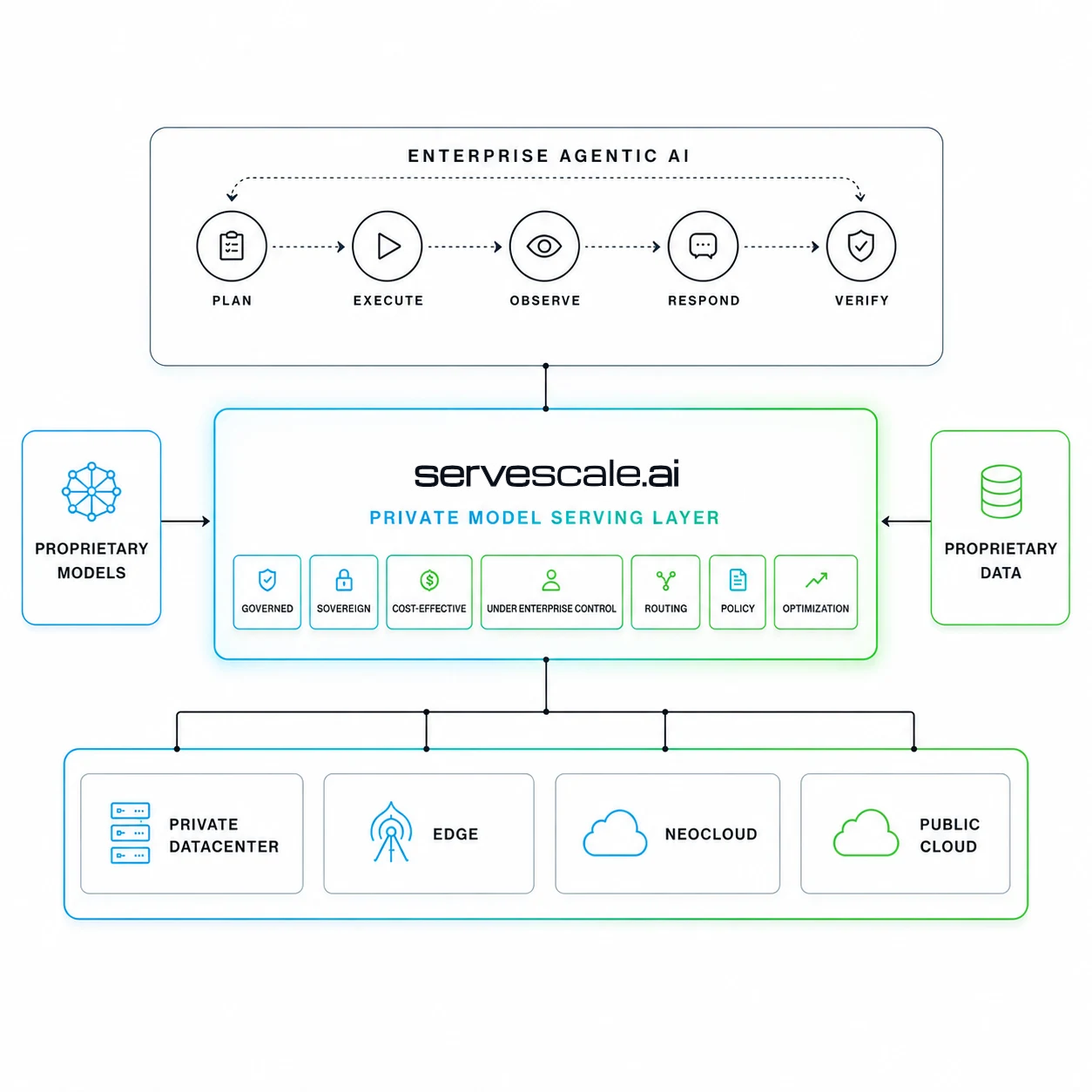
servescale.ai is built for that layer: make enterprise agentic AI highly differentiated, sovereign, and cost-effective across private datacenter, edge, neocloud, and public-cloud resources under enterprise control.